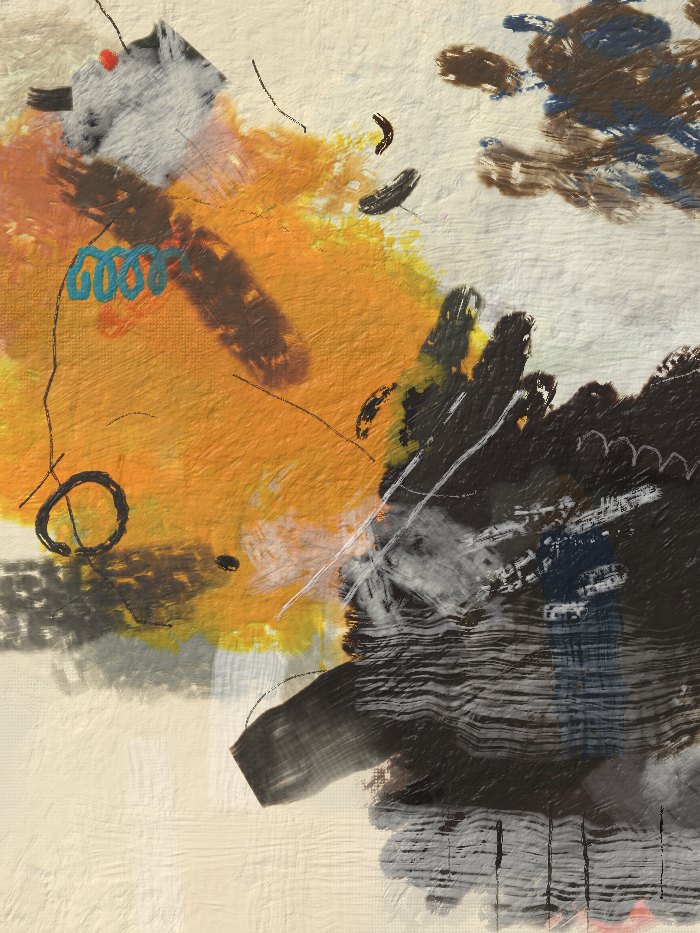
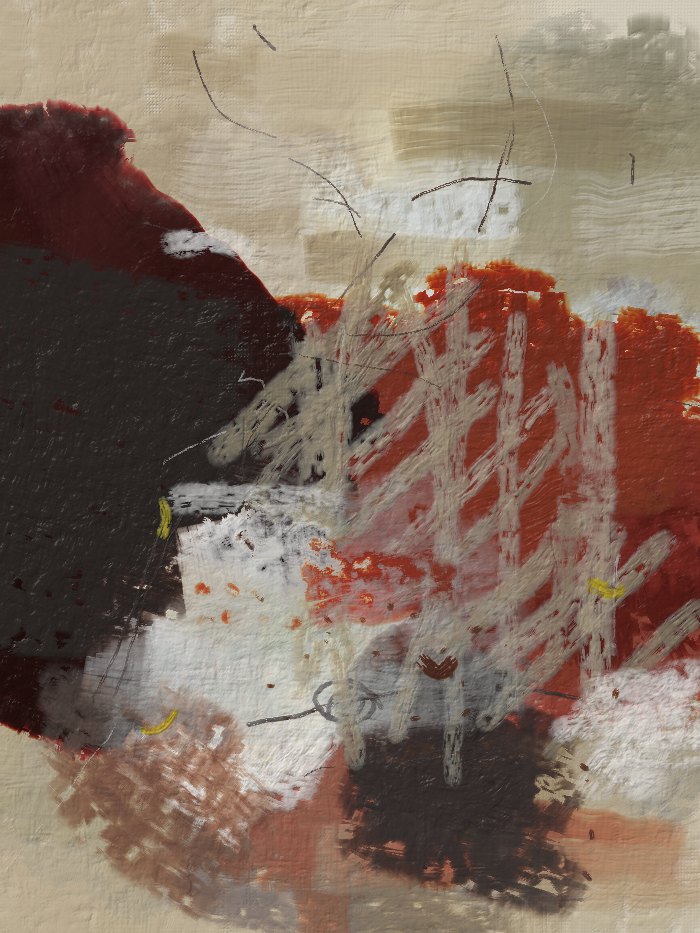
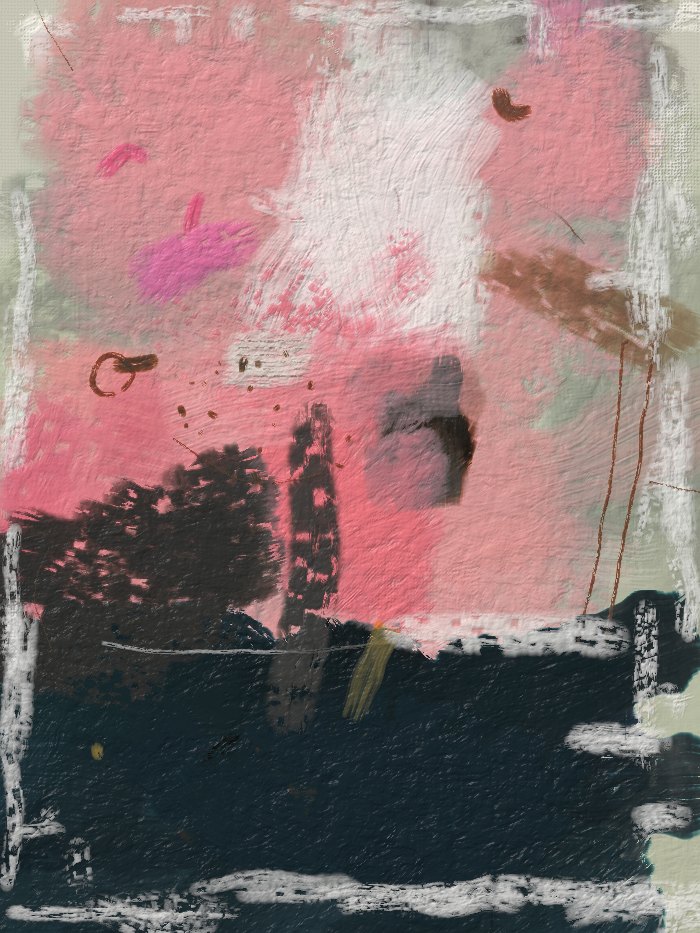
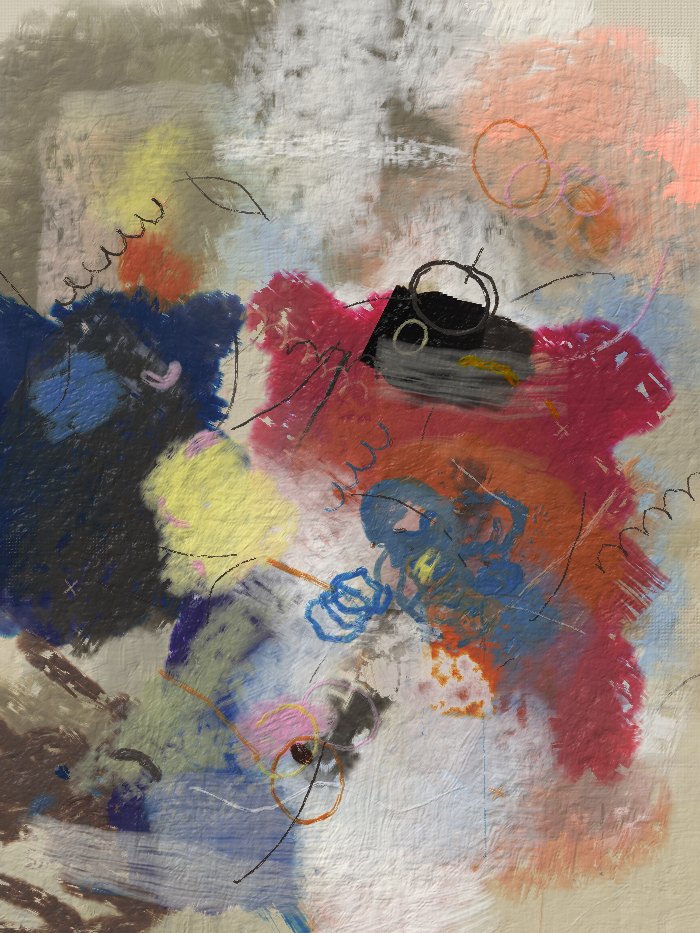
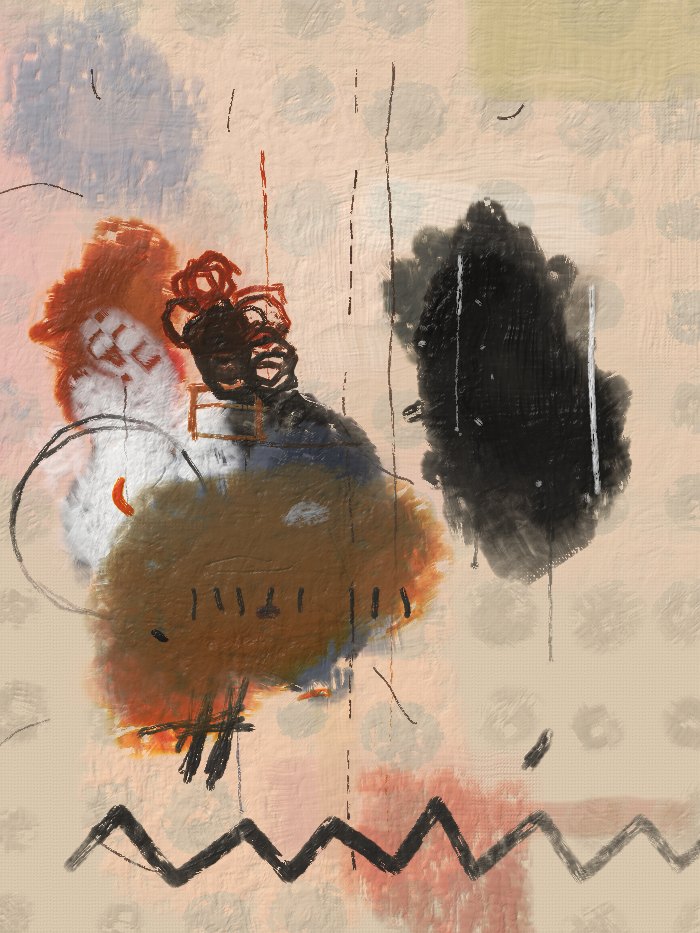
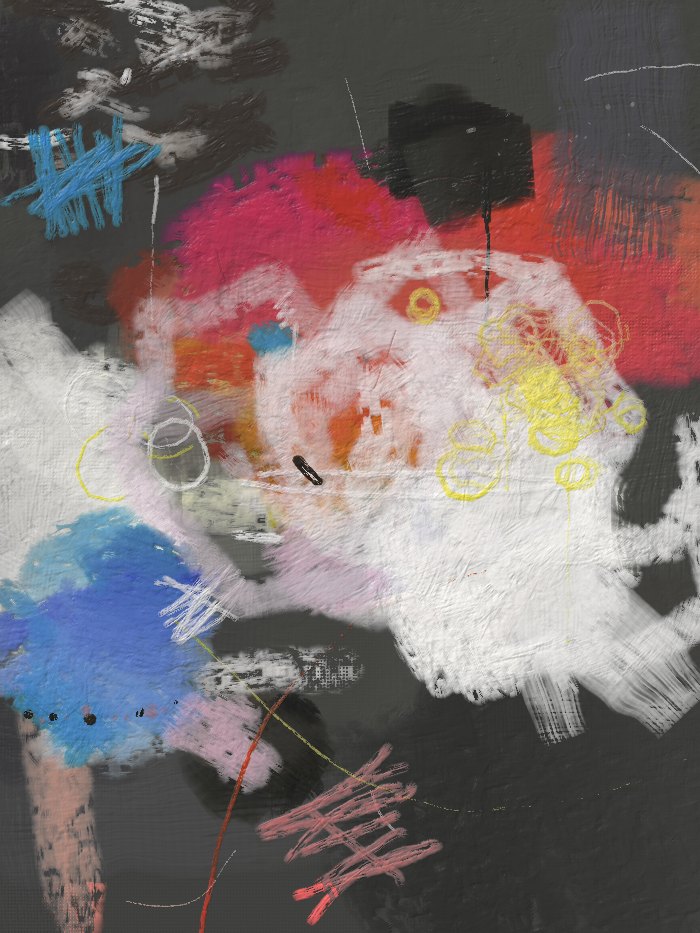
Veladuras is the second work on my acrylic paint simulation, after Pentimenti. Pentimenti was about the correction: a shape moved, the old one showing at the edge. Veladuras is about the covering.
Every real abstract I keep coming back to was painted over days. You can see it: a pink under a pink, an ochre ghost under a grey, a scraped patch where a knife went back through a veil that had not quite set. The picture is not a composition laid down once; it is the top of a stack, and the stack shows. I wanted an algorithm whose output has that property for the same reason a painting does — not painted to look layered, but layered.
So the engine is a surface, not a drawing tool. Each pixel carries a cured film and a wet film; a fresh coat over a cured one starts a new film and the old one becomes history; a knife scrapes the wet film down to a translucent facet and carries the surplus away; a dry brush catches only the ridges of earlier strokes; the colours mix as pigments mix, so a thin white over a dark is milk and a thin dark over a pale is a glaze. A brush is a reservoir that runs dry and picks up what it crosses. Bristles drift and lift. The blade wobbles. Nothing is stamped.
On that surface the painting is planned as sittings. A ground is worked thin, wiped, scraped. Two or three generations of earlier shapes go on in off-colours and are half-buried under a pale veil, and while the veil is open an unloaded blade goes back through it. The masses come in an armature — a dominant warm mass off-centre, a deep zone leaning on an edge, a smaller cool mass, a light slab, a few small darks — each painted first in another colour, cured, then built again in two or three tones, knifed, dragged out dry at the edge. A later sitting buries their edges in field colour and scrapes back before it closes. The newest paint goes on last. A third of the canvas is kept quiet and calmed with wide veils at the end. Then the responses: a contour re-drawn where a mass was moved, a hatch that notes it, a seam of fluorescent colour along a boundary, a ring drawn three times that never closes.
The vocabulary was not invented. I measured seven sets of paintings I love — their value range, their chroma, how massed they are at the scale of a hand, how much of the surface is dead-flat — and built to those numbers, and I sorted hundreds of outputs and fitted the weights to what I kept. The registers are the five densities those paintings actually came in. The palettes are theirs and mine.